




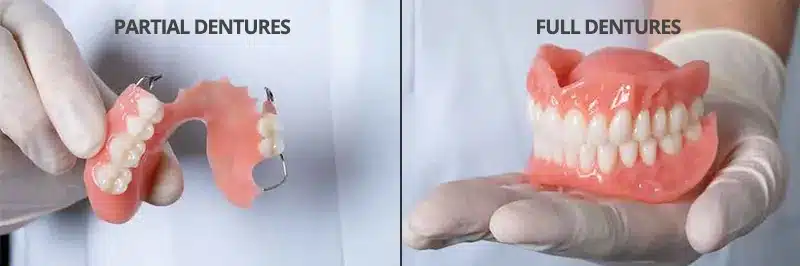
If you are looking to get dentures because you are missing multiple teeth or even all of your teeth, there’s likely been some thought about whether partial or full dentures will work best for you. The real answer lies in the number of teeth that are natural and healthy in your mouth.
The fact is that both kinds of dentures are there to give you replacement teeth in order for you to be able to chew, talk, and smile with more confidence. The determining factor for which denture you get boils down to a single question.
Understanding the Difference Full Dentures and Partial Dentures
Full dentures replace an entire arch of teeth, either the top or the bottom, when no natural teeth remain in that arch. Partial dentures fill in the gaps left by missing teeth while working around the natural teeth you still have.
Think of it this way. If your dentist looks in your mouth and sees healthy teeth mixed in with empty spaces, a partial is usually built around that. If there’s nothing left to work around, a full denture becomes the more realistic option.
Let us take an example of a person who is already in their 50’s or 60’s and who has almost all upper teeth gone because of long-term decay and gum disease. What is left is loose and cannot be saved. In such a situation, it is quite possible that the dentist will recommend removing everything that is there and starting with a full denture.
Let us imagine another case when a person is already 50 years old and who has no teeth at all on the right side but healthy teeth everywhere else. Removal of those remaining teeth does not make any sense. Partial dentures, which attach to the natural teeth in the area of use, will be more suitable for him.
| Factor | Full Dentures | Partial Dentures |
| Teeth replaced | An entire arch, upper or lower | Select missing teeth within an arch |
| Remaining natural teeth | None left in that arch | Some healthy natural teeth remain |
| Typical use | Extensive tooth loss or extraction of failing teeth | Gaps between otherwise healthy teeth |
| Stability considerations | Relies on the gum ridge and jawbone for fit | Often clips onto nearby natural teeth for added stability |
| Treatment considerations | May involve extractions and a healing period before final fitting | Usually requires fewer extractions, with impressions taken around existing teeth |
| May be combined with other options | Can be paired with dental implants for added stability | Can sometimes transition to fixed options if remaining teeth are eventually lost |
How Tooth Loss Affects Your Denture Options
The number of missing teeth matter more than most people expect.
- Missing a few teeth in one area: A partial denture is often considered here, since it fills the gap without disturbing the rest of your smile.
- Missing teeth scattered across the mouth: Depending on how many strong teeth remain, a partial may still work, but your dentist will look closely at how it can be supported.
- Missing all or nearly all teeth in one arch: This is typically where a full denture comes in, since there isn’t enough remaining tooth structure to hold a removable partial in place.
Remaining natural teeth also affect the decision in another way. Healthy teeth next to a gap can act as anchors for a partial. Teeth with advanced decay, deep gum pockets, or bone loss may not hold up well as anchors, even if they’re still present.
Choosing the Right Denture Type for Your Tooth Loss
Both types of dentures take some getting used to. That said, a few practical differences tend to come up in conversation with patients.
- A full denture rests on the gum ridge, so fit and suction matter for stability, especially when eating firmer foods.
- A partial denture usually feels more stable right away because it attaches to existing teeth, though the clasps can feel noticeable at first.
- The voice would have a different sound with both options for one or two weeks, and this usually gets better as you adjust to it.
- Dentures need to be checked regularly by the dentist for any irritation or looseness.
Now consider a patient who wants a faster replacement option. In these situations, a dentist may discuss options that allow a denture to be placed the same day teeth are removed, so the patient isn’t without a smile during the waiting period. Same-day dentures in Commerce City can be a reasonable starting point, with adjustments made as the gums heal and settle.
What are the Steps Involved in the Denture Treatment Process?
Each situation will vary but a typical procedure for dentures in Aurora, CO, might start out with an oral examination, impressions or scans of the mouth, as well as a discussion about any teeth that need to be removed prior to placing the dentures. After that, your dentist can guide you on the time required, whether or not a healing phase is required, and the number of fitting appointments.
Dental care and maintenance of dentures is important as well. Dentures that can be removed are meant to be cleaned on a daily basis as well as kept in the right storage place.
How Dentures Compare With Implants
Some patients ask about dentures vs implants before making a final decision, and it’s a fair question. Removable dentures are generally less involved upfront and can be a practical solution for many patients. Implant-supported options, sometimes combined with a denture for added stability, may offer more security for patients who want less movement during eating and speaking.
You can read more about how implant-supported dentures work if that route is something you want to explore further, or compare it with full arch dental implant options if most or all of your teeth in an arch need replacing. Your dentist can help you weigh the differences based on your bone health, budget, and goals, rather than a one-size-fits-all answer.
FAQs
How do I know if I need full dentures or partial dentures?
It all depends on the number of teeth you have and their condition. Your dentist will tell you more about that after the exam and X-rays because tooth and gum conditions differ greatly depending on a person.
Can partial dentures become full dentures over time?
Yes, but in a few cases. Cases when remaining natural teeth will fall out, then a partial denture may be changed into a full one. You can discuss that with your dentist.
Are same-day dentures possible for everyone?
No. There are many factors which affect the decision whether one can get such dentures or not, for instance gum condition, bone structure and if extractions are needed or not. A consultation is the best way to get to know if you are a candidate for that or not.
Will my dentures look natural?
Dentures are meant to look natural, and with proper installation, they shouldn’t affect the ability to talk and eat food. Though it takes some time to get accustomed to them.
Should I get dentures or implants?
It depends on your goals, oral health, and budget. Some patients prefer the simplicity of removable dentures, while others want the added stability that implant-supported options may offer. Discussing both during a denture consultation can help clarify which direction fits your needs.
