




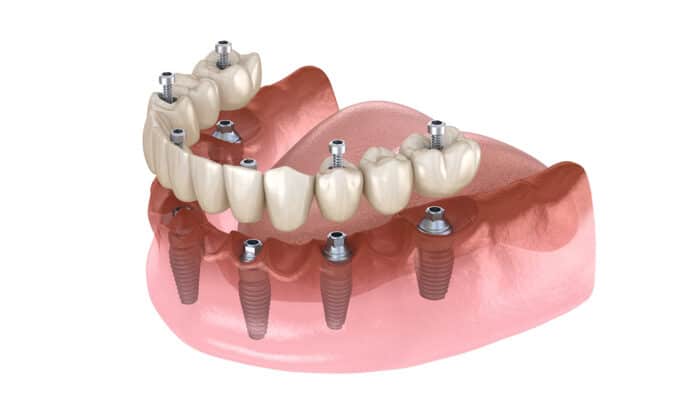
You wouldn’t build a house without first surveying the land to ensure a solid foundation. The same principle applies to placing dental implants. Your jawbone is the foundation for your new teeth, and its health is critical for long-term success. A dental CT scan acts as that essential survey. It gives our prosthodontist a detailed, three-dimensional view of your bone structure, measuring its height, width, and density. This information tells us exactly where to find the strongest support for your All-on-4 implants. Our dicc.ct imaging process is the first step in building a beautiful, durable smile that’s designed to last a lifetime.
Are you planning to have All on 4 implants? If so, then you will need to understand if you are suitable for the procedure. It is actually a long process that may require CT scanning. At Dental & Implant Centers of Colorado, we offer Free Consultation and CT-Scanning when needed.
What is a Dental CT Scan?
If you’re considering a significant dental procedure, you might hear your dentist mention a CT scan. A dental cone beam computed tomography (CT) scan is a special type of x-ray that creates a highly detailed, three-dimensional image of your mouth. Think of it like this: a standard x-ray is a flat photograph, while a dental CT scan creates a 3D model of your teeth, jaw, soft tissues, and nerve pathways. This technology gives your dental team a complete and accurate picture of your oral anatomy from every angle, which is something a simple 2D x-ray just can’t provide. It allows us to see the exact height and density of your jawbone, the location of your sinuses, and where your nerves are.
This comprehensive view is incredibly important for planning complex treatments with precision and care. For procedures like dental implants, knowing the exact landscape of your jaw is essential for a successful outcome. At Dental & Implant Centers of Colorado, we use this advanced imaging to ensure every treatment plan is perfectly tailored to your unique anatomy. It takes the guesswork out of the equation, allowing our specialists to map out your procedure with confidence and ensure your safety and comfort every step of the way. This is a key part of the expert, holistic care we provide to our patients across Colorado.
How It Differs from a Standard Dental X-ray
While both a standard dental x-ray and a CT scan give us a look inside your mouth, they provide very different levels of information. The most significant difference is the imaging capability. A traditional x-ray produces a two-dimensional image, which is excellent for spotting cavities between teeth but offers a limited view of your overall jaw structure. In contrast, a dental CT scan provides a 3D view that reveals critical details about your bone structure, nerve pathways, and soft tissues. This level of detail is what allows for much higher diagnostic precision, especially for complex cases.
This precision is why CT scans are the gold standard for planning procedures like All-on-4 implants. By creating a detailed 3D map, our team can virtually place the implants before the actual surgery, ensuring the ideal position for stability and longevity while avoiding sensitive areas. And while any scan involves radiation, dental CT scans are designed to use significantly less radiation than a conventional medical CT, making them a safe and effective tool for modern dental assessments. It’s all about using the best technology to create predictable, successful results for your smile.
Why Is a CT Scan Necessary for All-on-4 Implants?
We have a team of dental specialists and Dr. Dhawan, a Prosthodontist. Prior to your dental implant procedure, they will calculate the bone density for performing dental implants – The bone reabsorbs when you suffer from missing teeth. When the bone loss becomes significant, the scan will be able to determine the exact location to place an implant. When you do not have sufficient bone density, an all-on-4 implant may not be possible and you may be offered bone grafting. A CT scan is required that will enable our dental specialists to know the treatment options and to check the progress after your surgery. Dr. Dhawan provides exact measurements of your mouth and other dental structure you cannot see – If you have a low sinus cavity our specialist team may have to lift it before performing the implants. Having a scan will help him to place implants.
Why are we different?
- Our implants are done by a prosthodontist versus a general dentist in other dental offices.
- We have a state-of-the-art implant center with surgical suites and cutting-edge CBCT machines in the house so everything is done in one place by the specialist.
- We only use Nobel Biocare Implants, the gold standard in the industry.
- We have an in-house lab so we control quality, turn around faster, and even get things done the same day.
- We have a General Dentistry practice to help you maintain tour implants/dentures and oral health after your treatment.
Assessing Jawbone Health and Density
Think of your jawbone as the foundation for your new smile. For dental implants to be successful, they need a strong, healthy base to anchor into. When you lose teeth, the jawbone in that area naturally begins to shrink, a process called resorption. If significant time has passed, there might not be enough bone left to support an implant securely. A CT scan provides a detailed, 3D image that allows our specialists to measure the exact height and width of your jawbone. This information is critical for determining if you have sufficient bone density for the procedure or if a preliminary step like bone grafting might be needed to build up the area first.
Mapping Nerves and Sinuses for Safe Placement
Your jaw is home to important anatomical structures, including major nerves and your sinus cavities. The last thing you want is for an implant to interfere with any of them. A standard X-ray doesn’t show the precise location of these delicate areas, but a CT scan does. It creates a detailed map of your unique facial anatomy, allowing our team to see exactly where nerves and sinuses are. This is especially important for the upper jaw, where a low sinus cavity might require a gentle sinus lift before implants can be placed. This careful planning ensures your procedure is not only effective but also incredibly safe.
Creating a Precise Surgical Guide
Once we have a complete 3D picture of your jaw, we don’t just stop there. This digital information is used to create a custom surgical guide. This guide fits perfectly over your gums during the procedure and has precise openings that show the exact location, angle, and depth for each implant. It essentially removes any guesswork from the process, ensuring that the implants are placed in the optimal position for stability and to support your new teeth. This level of precision planning is key to the success of the All-on-4 treatment and helps us check your progress after the surgery is complete.
The CT Scan Process for All-on-4 in Broomfield and Beyond
Getting a CT scan for your dental implants is a quick and completely painless process. Unlike medical CT scanners that require you to lie down in a large tube, a dental Cone Beam CT (CBCT) scan is much simpler. You’ll sit or stand comfortably while the machine makes a single, quiet rotation around your head, which usually takes less than a minute. The best part? At Dental & Implant Centers of Colorado, we have state-of-the-art CBCT machines right in our offices. This means you don’t have to go to a separate imaging center; everything from your initial consultation to your final treatment is handled in one place by our specialist team, whether you visit us in Cherry Creek, Boulder, or Broomfield.
What to Expect During Your Consultation
Your journey toward a new smile starts with a conversation. When you come in for your free consultation, we’ll sit down to discuss your goals and what you hope to achieve. A key part of this initial meeting is the CT scan. This imaging gives us the essential information we need to determine if you’re a good candidate for All-on-4 dental implants. Dr. Dhawan, our prosthodontist, will review the scan with you, pointing out the key aspects of your anatomy and explaining your treatment options in a way that’s easy to understand. This is your opportunity to ask questions and get a clear picture of the path forward.
How We Use 3D Imaging for Treatment Planning
The 3D model created by the CT scan is the blueprint for your entire treatment. It allows our team to virtually place the implants on a computer before the actual surgery even begins. We can test different positions and angles to find the most secure placement that also provides the best support for your new set of teeth. This digital planning ensures every detail is considered, from the health of your jawbone to the final look of your smile. It’s a collaborative process that combines advanced technology with the expertise of our dental specialists to create a personalized and highly effective treatment plan just for you.
Benefits of CT-Guided Implant Surgery
At the best dental clinic in colorado, opting for a procedure guided by CT scan technology isn’t just about using fancy equipment; it’s about achieving a better, safer, and more reliable outcome. This advanced imaging provides a level of detail that is simply impossible to get from a traditional 2D X-ray. By having a complete, three-dimensional view of your jawbone, nerves, and sinuses, our surgical team can plan and perform your All-on-4 procedure with unparalleled precision.
This meticulous approach translates directly into significant benefits for you, not only on the day of your surgery but for many years to come. It’s the difference between hoping for a good result and planning for one from the very beginning.
Improved Accuracy and Predictability
When your surgery is planned using a 3D model of your mouth, the results are incredibly accurate and predictable. The surgical guide created from the CT scan ensures that each implant is placed at the exact depth and angle determined during the planning phase. This precision is crucial for the stability of the implants and the final fit and function of your new teeth. It eliminates surprises during surgery and leads to a final result that looks and feels natural. You can see the beautiful, predictable outcomes for yourself in our before and after gallery.
Enhanced Safety and Minimized Risks
Your safety is our top priority. CT-guided surgery significantly reduces the risks associated with dental implant procedures. By precisely mapping out the locations of sensitive structures like the nerve canal in the lower jaw and the sinus cavities in the upper jaw, we can place implants with confidence, avoiding any potential complications. This careful planning minimizes the risk of nerve damage, sinus perforation, and other issues, leading to a smoother procedure and a more comfortable recovery. It provides peace of mind, knowing that every precaution has been taken to protect your health.
Better Long-Term Success for Your Implants
The long-term success of your dental implants depends heavily on how well they are placed. Implants that are positioned in the densest available bone and at the correct angle are better able to withstand the forces of biting and chewing over the years. CT-guided surgery ensures this optimal placement, creating a strong foundation that is built to last. This meticulous approach is a key factor in achieving the high success rates associated with All-on-4 implants, giving you a beautiful, functional smile that you can rely on for a lifetime. It’s a vital part of the comprehensive dental services we provide to ensure your lasting oral health.
Frequently Asked Questions
Is the CT scan really included for free with the consultation?
Yes, it is. We believe that a thorough evaluation is the only way to create a truly effective treatment plan. The CT scan provides essential information that we need to determine if you are a candidate for All-on-4 implants. Including it in our complimentary consultation ensures you get a complete and accurate assessment from the start, without any financial commitment.
Is getting a dental CT scan uncomfortable or painful?
Not in the slightest. The process is incredibly simple and completely painless. You will either sit or stand comfortably while the machine makes a single, quiet rotation around your head. The scan itself is very quick, typically lasting less than a minute. There are no tight spaces or discomfort involved, making it an easy and stress-free experience.
What happens if the scan shows I don’t have enough bone for implants?
This is one of the most important reasons we perform the scan. If we find that your jawbone isn’t currently dense enough to support a full set of implants, it doesn’t mean the conversation ends. This information allows us to discuss other options, such as a bone grafting procedure, which can rebuild the bone to create a strong and stable foundation for your future smile.
Why can’t you just use a regular dental X-ray for this procedure?
An implant prosthodontist understands that a regular X-ray provides a flat, two-dimensional image, which is useful for spotting cavities but doesn’t give us the whole story. For a procedure as precise as All-on-4, we need a three-dimensional view. The CT scan creates a detailed 3D model of your jaw, allowing us to see the exact height and width of your bone and map the precise location of nerves and sinuses, which is critical for safe and successful implant placement.
How much radiation is involved with a dental CT scan?
Your safety is always our main concern. The Cone Beam CT (CBCT) technology we use in our offices is specifically designed for dental use and emits significantly less radiation than a conventional medical CT scan. The exposure is minimal and highly targeted, making it a safe and effective tool for gathering the detailed information we need to plan your treatment with the utmost precision.
Key Takeaways
- A CT scan provides the 3D blueprint for your new smile: Unlike a flat x-ray, it creates a detailed model of your jaw, allowing your specialist to measure bone density and find the strongest areas to place your implants.
- It’s a critical safety measure for your procedure: The scan precisely maps the location of sensitive nerves and sinus cavities, which allows your surgical team to avoid these areas and significantly reduce risks during implant placement.
- Precise planning leads to a predictable, long-lasting result: The 3D data is used to create a custom surgical guide, ensuring each implant is placed at the perfect angle and depth for optimal stability and long-term success.
For more insights, updates, and expert tips, follow us on LinkedIn.
