Multi Specialty Dental Clinic & Implant Center
Short answer
Most people pay for dental implants in layers: dental insurance pays its share first, money from a Health Savings Account (HSA) or Flexible Spending Account (FSA) covers part of the rest before tax, and financing spreads whatever is left into monthly payments.
Financing usually means a medical credit card such as CareCredit or a patient lender such as Cherry, Sunbit or Proceed Finance. Many offer 0% plans to qualified patients, but read the terms: some 0% offers are "deferred interest", which charges all the interest back if the balance isn't paid in time.
At DICC, you can spread the cost from 3 months to 10 years, subject to approval. See financing at DICC.
A dental implant is one of the best ways to replace a missing tooth, and one of the larger dental bills most people will ever see. The good news is that very few patients pay it all at once. Between insurance, tax-free health accounts and patient financing, most people can turn the cost into something that fits a monthly budget. This guide explains each option, how to combine them, and what to check before you sign anything.
Key Takeaways
- Use the cheapest money first: Insurance benefits and pre-tax HSA or FSA dollars cost you nothing extra, so they come before any loan.
- 0% isn’t always 0%: A “no interest if paid in full” offer charges back all the interest from day one if you miss the deadline. A true 0% APR plan doesn’t.
- Start with a written plan: Your consultation gives you the treatment plan and its cost, which is what lenders, insurers and your HSA or FSA all need.
What Is Dental Implant Financing?
Dental implant financing is any way of paying for implant treatment over time instead of in one payment. It ranges from a credit card made for health care, to a loan from a company that partners with your dentist, to a payment plan run by the dental office itself.
It’s worth knowing what you’re paying for before you choose. A single implant is usually billed in parts: the implant post, the abutment that connects it to the tooth, and the crown. Some patients also need an extraction, a bone graft or a 3D scan first. Our guide to the true cost of dental implants walks through each part.
How Do You Pay for Implants in Layers?
Think of your treatment cost as a stack. Each layer pays for part of it, starting with the money that costs you nothing extra.
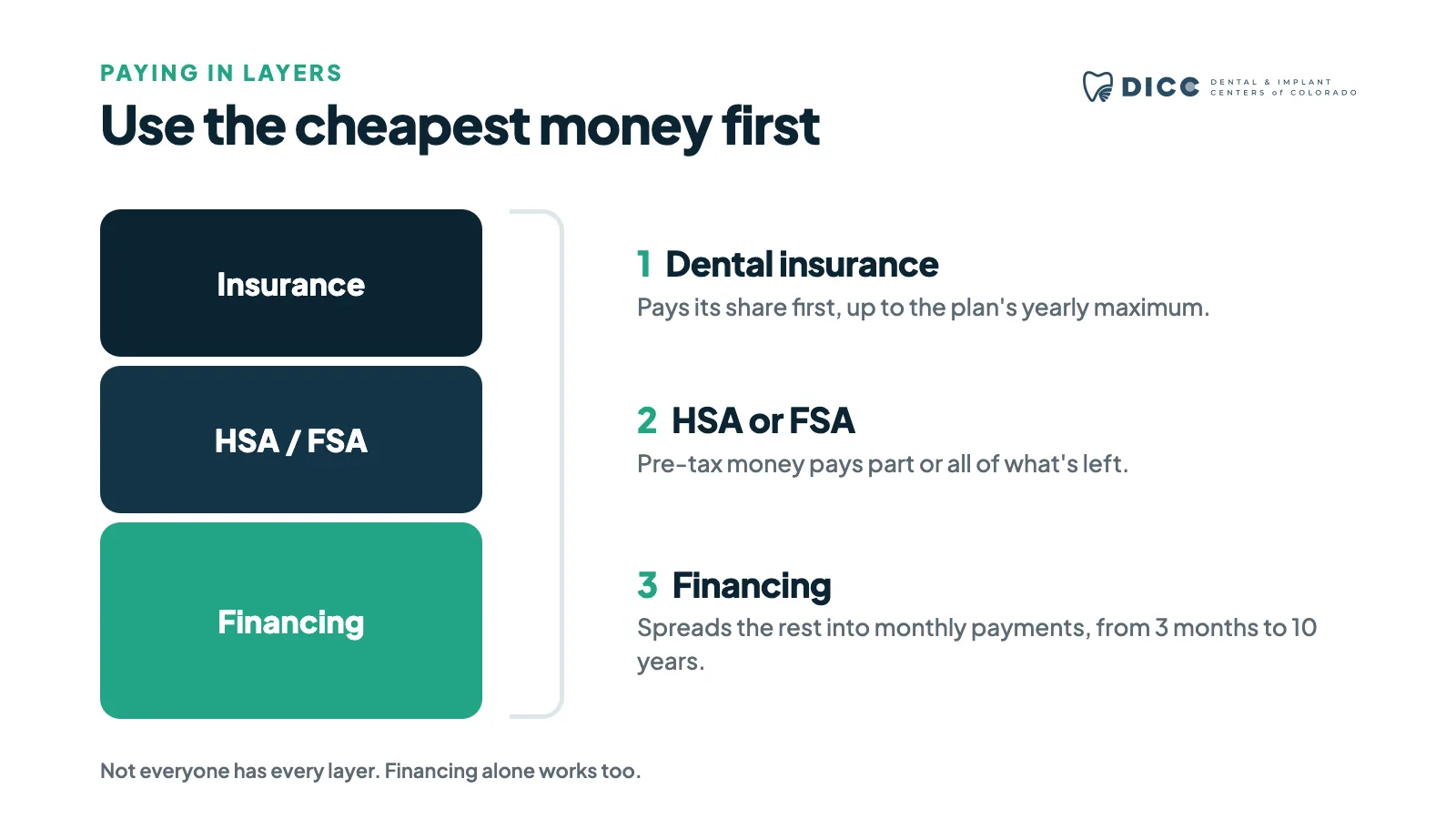
- Dental insurance. If your plan covers implants or parts of the treatment, it pays first, up to its annual maximum.
- Your HSA or FSA. Pre-tax money pays part or all of what’s left.
- Financing. A medical credit card, patient lender or payment plan spreads the remaining balance over months or years.
Not everyone has all three layers. That’s fine: financing alone works too. But checking the first two before you borrow can shrink the amount you finance.
Option 1: Dental Insurance
Many dental plans pay something toward implant treatment, even when they don’t cover the implant post itself. A plan might pay part of the crown, the extraction or the x-rays. Three things limit what you get:
- Annual maximum. Most plans cap what they pay each year. Larger treatment often uses it up.
- Waiting periods. Major work may not be covered until you’ve had the plan for a set time.
- Missing tooth clause. Some plans won’t pay to replace a tooth that was missing before you joined.
A useful trick: implant treatment often happens in stages over several months. If the stages fall in two plan years, you may be able to use two years of benefits. Ask us to check your plan before treatment starts. Read more in Dental Insurance Explained: What’s Covered, What’s Not.
Option 2: Your HSA or FSA
A Health Savings Account (HSA) or a health Flexible Spending Account (FSA) lets you pay for medical and dental care with money that hasn’t been taxed. Dental treatment that isn’t purely cosmetic, such as replacing a missing tooth, is generally an eligible expense under IRS rules. Check with your plan administrator before you pay.
For 2026, the IRS lets you put in up to:
| Account | 2026 limit |
|---|---|
| HSA, self-only coverage | $4,400 |
| HSA, family coverage | $8,750 |
| Extra HSA contribution if you’re 55 or older | $1,000 |
| Health FSA | $3,400 |
HSA money rolls over from year to year and stays yours if you change jobs, so it’s worth saving into one ahead of planned treatment.
FSA money is often “use it or lose it”. Some plans let you carry a small amount into the next year or give you a grace period, but much of an unspent balance can be lost. If you have FSA money left near the end of the year, a consultation or the first stage of treatment may be a good use for it. A health FSA also usually makes your full yearly amount available from the first day of the plan year, even though it’s paid in from each paycheck.
You can’t usually hold an HSA and a general-purpose health FSA at the same time. Your employer’s benefits team can tell you which one you have.
Option 3: Medical Credit Cards
A medical credit card, such as CareCredit, is a credit card for health care costs, including dental treatment. CareCredit’s promotional offers on qualifying purchases of $200 or more run for 6, 12, 18 or 24 months, and longer plans at a fixed interest rate are also available.
The thing to understand is deferred interest. On a “no interest if paid in full” promotion, interest builds up from the day of the purchase. If you pay the whole balance before the promotion ends, you pay no interest. If any of it is still unpaid, all the interest that built up since day one is added to your account.
The safe way to use it: divide the balance by the number of months in the promotion, and pay at least that much every month, not just the minimum payment.
Option 4: Patient Financing Lenders
Companies such as Cherry, Sunbit and Proceed Finance lend directly to patients for treatment at offices they work with. They differ from a credit card in a few ways:
- Checking your options is usually quick and often uses a soft credit check that doesn’t affect your score. A full credit check may come later if you accept a loan.
- The plan is a fixed loan with a set number of payments, so you know when it ends.
- Some offer true 0% APR to qualified patients, where no interest is charged back if you pay on schedule. Others charge interest, and the rate depends on your credit.
- Longer terms are available for larger treatment, such as full-arch implants.
Option 5: In-House Payment Plans
Some dental offices let you pay them directly in installments, without a lender. At DICC, in-house payment plans are available on request for select treatments. Ask at your consultation whether your treatment qualifies.
Other Ways to Pay
- A personal loan from a bank or credit union can have a lower rate than a credit card if your credit is good.
- A regular credit card works, but its standard interest rate makes it one of the most expensive ways to carry a balance.
- A tax deduction. If you itemize, the IRS lets you deduct medical and dental costs above 7.5% of your adjusted gross income. Most people don’t reach that threshold, but a large implant bill sometimes does. Ask a tax professional.
How the Options Compare
| Option | Interest | Good to know |
|---|---|---|
| Dental insurance | None | Limited by the annual maximum and waiting periods |
| HSA or FSA | None, and paid before tax | Check eligibility with your plan administrator |
| Medical credit card | 0% during a promotion, then the card’s rate | Deferred interest if not paid in full in time |
| Patient financing lender | 0% APR for some, otherwise a fixed rate | Fixed payments and end date |
| In-house payment plan | Depends on the office | Select treatments only |
What Does a Payment Plan Look Like?
Here’s simple math on a $4,000 balance left after insurance and your HSA or FSA, with no interest:
- Over 12 months: about $333 a month.
- Over 18 months: about $222 a month.
- Over 24 months: about $167 a month.
With an interest-bearing plan, the monthly payment and the total you pay will be higher. Your lender will show you both before you accept.
Questions to Ask Before You Sign
- Is this a true 0% APR plan, or a deferred-interest promotion?
- What is the interest rate after any promotional period ends?
- How many payments, and how much is each?
- Is there a fee to apply, a fee for paying late, or a penalty for paying early?
- Will checking my options affect my credit score?
- Does the financed amount cover the whole treatment, or only the first stage?
How to Pay for Implants at DICC
Your first dental implant consultation at DICC is free and with no obligation. Dr. Kaushal Dhawan, our prosthodontist, examines your mouth, takes a 3D scan if you need one, and gives you a written plan with the cost of each step. Our team then goes through your insurance and financing with you.
At DICC you can:
- Spread the cost from 3 months to 10 years, subject to approval, with CareCredit, Cherry, Sunbit or Proceed Finance.
- Apply for 0% financing with Cherry, for qualified patients.
- Ask about in-house payment plans for select treatments.
- Pay with cash, credit or debit cards, or your HSA or FSA card.
- Use your dental insurance. We accept most plans and can check what yours pays before you start.
See every option on our financing page, and check our special offers for current promotions.
Frequently Asked Questions
Can I finance dental implants with bad credit?
Often, yes. Patient lenders look at more than your credit score, and some approve a wider range of applicants than a bank would. The interest rate may be higher. Checking your options usually doesn’t affect your score, so it’s worth asking.
Does applying for dental financing hurt my credit?
Checking your options with many patient lenders uses a soft credit check, which doesn’t affect your score. Accepting a loan or opening a credit card can involve a full credit check. The lender will tell you which applies before you agree.
Can I use my HSA or FSA for dental implants?
Generally, yes, when the implant replaces a missing or failing tooth rather than being purely cosmetic. Confirm with your plan administrator, and keep your treatment plan and receipts.
Can I combine insurance, an HSA and financing?
Yes. Insurance pays its share, your HSA or FSA can pay part of what’s left, and financing can cover the rest. Your dental office can help you work out each amount.
Is a 0% financing offer really free?
A true 0% APR loan is, if you make every payment on time. A deferred-interest promotion is free only if you pay the whole balance before it ends; otherwise, all the interest from the start is added.
Related Articles
- What Is the True Cost of Dental Implants?
- What Is the Average Cost of Dental Implants in Colorado?
- Dental Insurance Explained: What’s Covered, What’s Not
- Bone Grafting for Dental Implants Cost: A Breakdown
Planning an implant? Dr. Kaushal Dhawan sees implant patients at all three offices: Cherry Creek, Boulder and Westminster/Broomfield.