Multi Specialty Dental Clinic & Implant Center
Short answer
Sometimes, and usually only in part. More dental plans cover implants than a few years ago, but many still treat them as optional and pay only for part of the treatment, such as the crown or the extraction. Plans that do cover implants usually pay around half, up to a yearly maximum that is often lower than the cost of one implant.
Four things decide what you get: the plan's annual maximum, any waiting period, a "missing tooth clause", and whether it pays only what a cheaper option such as a bridge would cost.
At DICC, we accept most dental insurance and check what your plan pays before treatment starts. See insurance at DICC.
If you’re missing a tooth, the first question is usually what it will cost, and the second is whether your insurance will help. The honest answer is that it depends on your plan, and the details that matter are often in the small print. This guide explains how dental plans handle implants, the clauses that reduce what they pay, what Medicaid and Medicare cover, and how to find out exactly what your plan will pay before you start.
Key Takeaways
- Check the plan, not the insurer: Two plans from the same company can treat implants completely differently. What matters is your plan’s own benefits.
- The annual maximum is the real limit: Even a plan that pays 50% for implants stops paying once it reaches its yearly maximum.
- Ask for a pre-treatment estimate: Your dental office can send your treatment plan to your insurer and get, in writing, what it expects to pay.
Does Dental Insurance Cover Dental Implants?
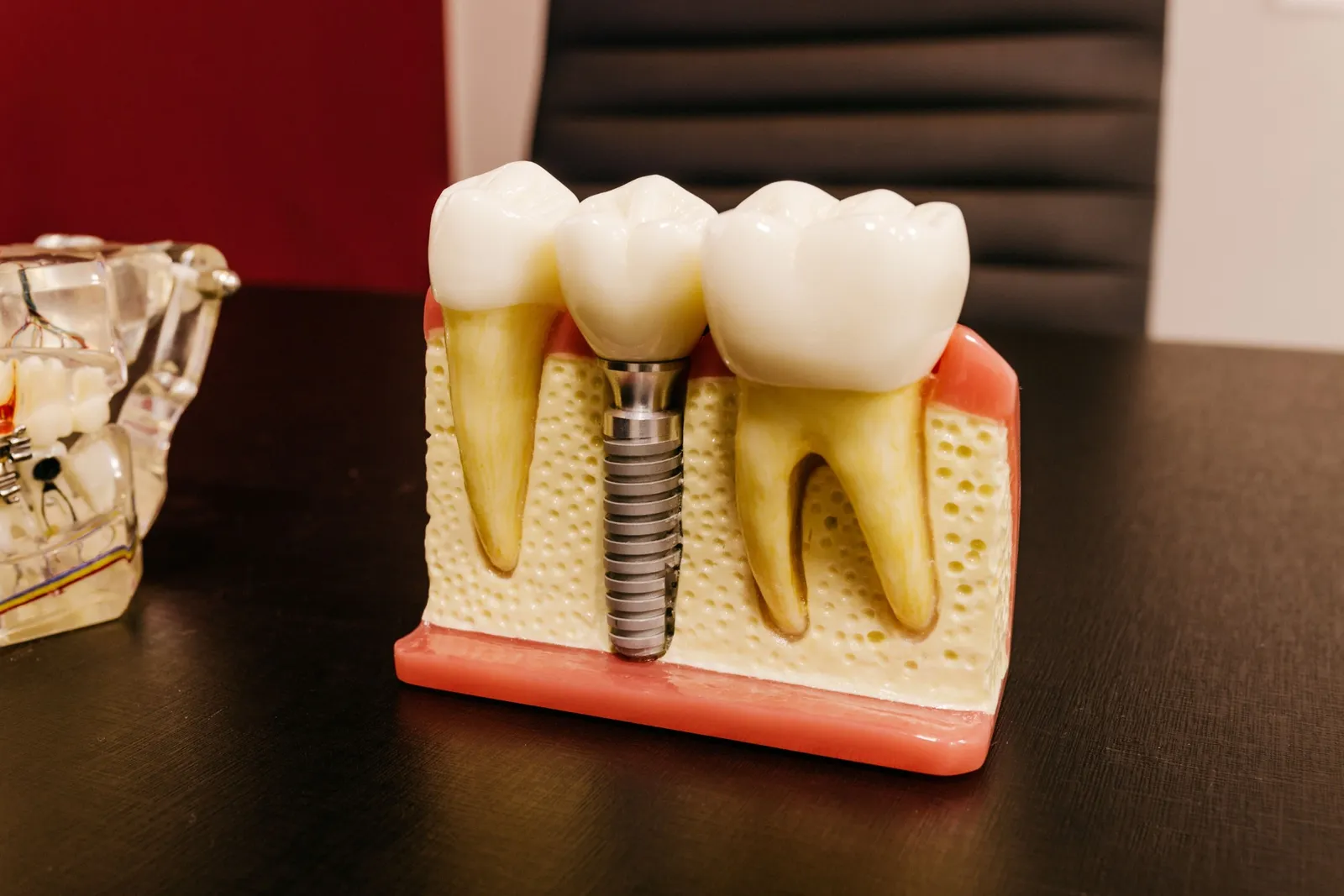
Some plans cover implants, and many cover at least part of the treatment. A dental implant is usually billed in parts: the implant post placed in the jaw, the abutment that connects it to the tooth, and the crown on top. Some patients also need an extraction, a bone graft or a 3D scan first.
A plan can treat each part differently. One plan may pay for everything; another may refuse the implant post but pay toward the crown, the extraction and the x-rays. That’s why “does my insurance cover implants?” rarely has a yes or no answer. The useful question is “how much will my plan pay for this treatment plan?”
How Dental Plans Pay for Implants
Most dental plans sort treatment into three groups:
| Type of care | Examples | Typical share the plan pays |
|---|---|---|
| Preventive | Cleanings, exams, x-rays | Often 100% |
| Basic | Fillings, simple extractions | Often 70–80% |
| Major | Crowns, bridges, dentures, implants | Often 50%, if covered |
These are typical figures, not promises; your plan’s own benefits are what count. On top of the percentage, three limits apply:
- Deductible. The amount you pay each year before the plan starts paying, often around $50.
- Annual maximum. The most the plan will pay in a plan year. Many plans set this at $1,000 to $2,000, and one implant can use all of it.
- Lifetime or per-tooth limits. Some plans also limit how often they’ll replace the same tooth.
Five Things That Decide What Your Plan Pays
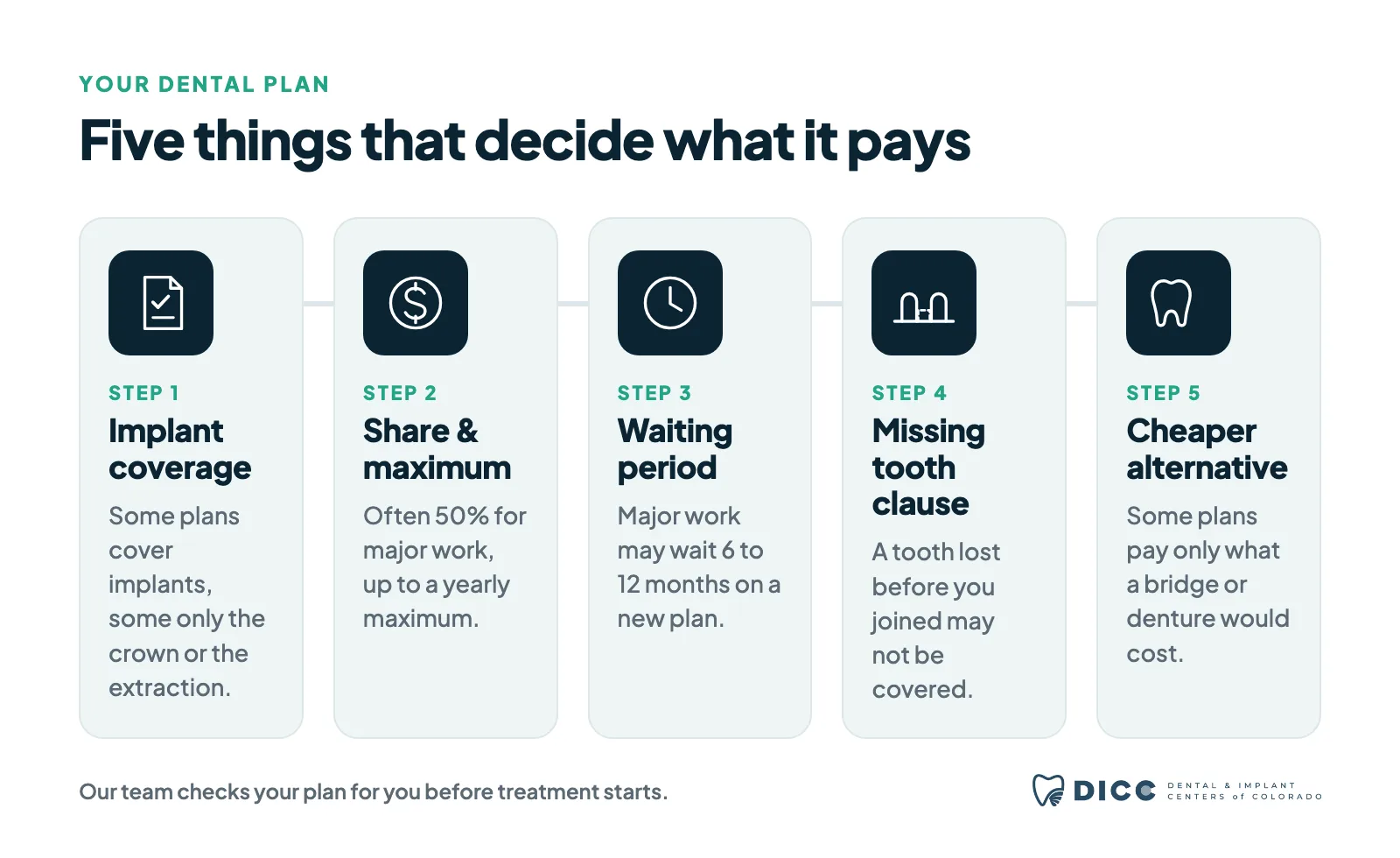
1. Whether implants are a covered benefit
Some plans list implants as covered. Others exclude them and pay only toward the parts of the treatment they do cover, such as the crown. Your plan’s summary of benefits says which.
2. The share and the annual maximum
A plan that pays 50% of a major treatment still stops at its annual maximum. If your treatment costs more than twice the maximum, the maximum is what limits you, not the percentage.
3. The waiting period
Many individual plans make you wait before major work is covered, often 6 to 12 months from the day the plan starts. Plans through an employer often have shorter waiting periods or none.
4. The missing tooth clause
Some plans won’t pay to replace a tooth that was already missing on the day your coverage began. This is usually listed under exclusions. If you lost the tooth while you had the plan, the clause doesn’t apply.
5. The “cheaper alternative” rule
Many plans include what the American Dental Association calls a least expensive alternative treatment clause. When there are several ways to replace a tooth, the plan pays only what the least expensive one would cost, such as a bridge or a partial denture. You can still choose the implant; you pay the difference.
An Example: How the Numbers Work
Here’s a simple example with made-up numbers. Your own plan and treatment will differ.
Say your implant treatment costs $4,500, and your plan pays 50% of major work with a $1,500 annual maximum.
- 50% of $4,500 is $2,250, but the plan stops at its $1,500 maximum.
- You pay the remaining $3,000, plus any deductible.
Now say the treatment is done in two stages that fall in two plan years: the implant post this year ($2,500), and the abutment and crown next year ($2,000).
- This year the plan pays 50% of $2,500: $1,250.
- Next year it pays 50% of $2,000: $1,000.
- The plan pays $2,250 in all, and you pay $2,250.
Implant treatment often takes several months anyway, because the jaw needs time to heal around the implant. If your stages can fall on either side of your plan’s renewal date, you may be able to use two years of benefits. Ask us to check before treatment starts.
Does Medicaid Cover Dental Implants in Colorado?
Colorado’s Medicaid program, Health First Colorado, covers dental care for adults, including exams, cleanings, fillings, extractions and dentures for many members. For most adult members, implants are not a covered benefit, according to the adult benefit summary from DentaQuest, which runs the dental program. Some members on home and community-based waiver programs have limited implant coverage, for example to support a bridge or steady a denture.
Rules change, so check your own benefits with DentaQuest or Health First Colorado. DICC accepts Health First Colorado; see Medicaid at DICC.
Does Medicare Cover Dental Implants?
Original Medicare (Parts A and B) doesn’t cover routine dental care, including implants, except in a few cases tied to other medical treatment. Some Medicare Advantage plans include dental benefits, and a few pay toward implants, usually with their own yearly limit. If you have a Medicare Advantage plan, check its dental section or call the plan.
What If Your Plan Doesn’t Cover Implants?
You still have options:
- Use what the plan does cover. Even without implant coverage, the plan may pay toward the exam, x-rays, extraction or crown.
- Use your HSA or FSA. Replacing a missing tooth is generally an eligible expense, paid with money before tax.
- Spread the cost. Patient financing can turn the rest into monthly payments. Our guide to dental implant financing explains each option.
- Look at a plan that covers implants at your next open enrollment, keeping waiting periods in mind.
- Consider a dental savings plan. These aren’t insurance; they give you discounted fees at dentists who take part.
How to Check What Your Plan Will Pay
- Find your plan’s summary of benefits and look for “implants”, “major services” and the “exclusions” section.
- Note the annual maximum and how much of it you’ve already used this year.
- Ask about waiting periods and any missing tooth clause.
- Get a written treatment plan at your consultation, with the procedure codes for each step.
- Ask for a pre-treatment estimate. Your dental office sends the plan to your insurer, which replies with what it expects to pay. It isn’t a guarantee, but it’s the closest thing to one.
Insurance and Implants at DICC
Your first dental implant consultation at DICC is 100% free, with no exam fee and a 3D scan included. Dr. Kaushal Dhawan, our prosthodontist, examines your mouth and gives you a written plan with the cost of each step. Our team then checks your insurance with you.
At DICC we:
- Accept most dental insurance, including Delta Dental, Cigna, Blue Cross Blue Shield, UnitedHealthcare, MetLife and Guardian. See every plan on our insurance page.
- Accept Health First Colorado (Medicaid) and go through what it covers and the alternatives before any treatment.
- Can send your treatment plan to your insurer for a pre-treatment estimate.
- Offer financing from 3 months to 10 years, subject to approval, and accept HSA and FSA cards. See financing.
Frequently Asked Questions
Why don’t some dental plans cover implants?
Because cheaper ways to replace a tooth exist, such as a bridge or a denture, some plans treat implants as optional. Others cover them but pay only what the cheaper option would cost.
Is there dental insurance with no waiting period for implants?
Some plans, especially through employers, have no waiting period for major work. Individual plans that cover implants straight away often have higher premiums or lower annual maximums. Compare the total you’d pay, not only the monthly premium.
Can I buy dental insurance after I lose a tooth?
You can, but a missing tooth clause may stop the plan paying to replace a tooth you lost before joining. Check the exclusions before you buy.
Will my insurance pay for an implant crown?
Often, yes. Many plans that exclude the implant post still pay toward the crown, usually as major work at around 50%, up to the annual maximum.
Does medical insurance ever cover dental implants?
Rarely, but it can, for example when a tooth is lost in an accident or because of a medical condition or its treatment. Ask your medical insurer, and keep the records that explain why the tooth was lost.
Related Articles
- Dental Insurance Explained: What’s Covered, What’s Not
- How to Finance Dental Implants: Payment Plans, Medical Credit, HSA and FSA
- What Is the True Cost of Dental Implants?
- What Happens at a Dental Implant Consultation
Planning an implant? Dr. Kaushal Dhawan sees implant patients at all three offices: Cherry Creek, Boulder and Westminster/Broomfield.